The Hidden Battle in Steel Leveling: Taming Residual Stress Beyond Surface Flatness

Jay Zheng
19 авг. 2025 г.
Q: If steel plates pass flatness inspection at the leveling plant but warp after cutting, is residual stress always the culprit?
A: Not necessarily! Thermal stress from uneven expansion during hot cutting (localized temperatures >1,200°C) is often the primary cause. Rapid verification method: Rotate the same plate 90° before cutting. If deformation patterns change, thermal stress dominates; symmetric warping (e.g., left-bending paired with right-bending) indicates residual stress.
Q: How should responsibility be allocated when post-cutting deformation occurs despite acceptable delivered flatness?
A: Accountability requires tripartite collaboration:
- Steel mills (Primary): Non-uniform cooling during thermo-mechanical controlled processing (TMCP) creates widthwise stress gradients (edge stress 60 MPa > center). Levelers lack roll-bending capabilities to fully correct this.
- 2.Leveling plants (Secondary): High-strength steels (e.g., DP780) demand precise thermal control—a 20% line-speed increase causes ±8% yield strength fluctuation, necessitating dynamic reduction compensation.
- End users (Critical): Blast cleaning before cutting removes oxides that exacerbate thermal deformation. Pre-cut stress-relief annealing further mitigates risks.
Q: What is the core mechanism for residual stress elimination during leveling?
A: Stratified plastic deformation achieves stress redistribution:
- Surface layer (>80% plastic deformation): Roller pressure forcibly restructures grain orientation, disrupting original stress patterns.
- Core layer (elastic state): Partially inherits stress but acts as a stabilized "stress reservoir," preventing localized concentration.
Q: Does increasing reduction linearly reduce residual stress?
A: No—it follows a U-curve relationship:
- Under-reduction (plastic deformation <80%): Leaves original stress intact.
- Over-reduction: Introduces new bending stress exceeding eliminated stress. Case study: Increasing reduction from 1.2mm to 1.8mm for Q355 steel raisedresidual stress by 15%.
Q: How does equipment condition affect stress distribution?
A: Mechanical defects directly induce stress imbalance:
- Roll misalignment → Unilateral stress spikes.
- Worn rollers → Wave-like stress distribution.
- Insufficient frame rigidity → 0.12mm frame deflection under 3,000-ton loads transfers as internal stress (15% of plate thickness).
Q: How do plants quantify residual stress control given measurement limitations?
A: Industry relies on empirical methods due to detection challenges:
- X-ray diffraction: Limited to 0.1mm surface depth.
- Ultrasonic testing: Requires extensive calibration.
- Practical test: Cutting a 30mm strip along the rolling direction. Warping >3mm/m triggers immediate parameter adjustments.
Q: What integrated solutions balance precision and adaptability?
A: Synergizing hardware, data, and process innovation:
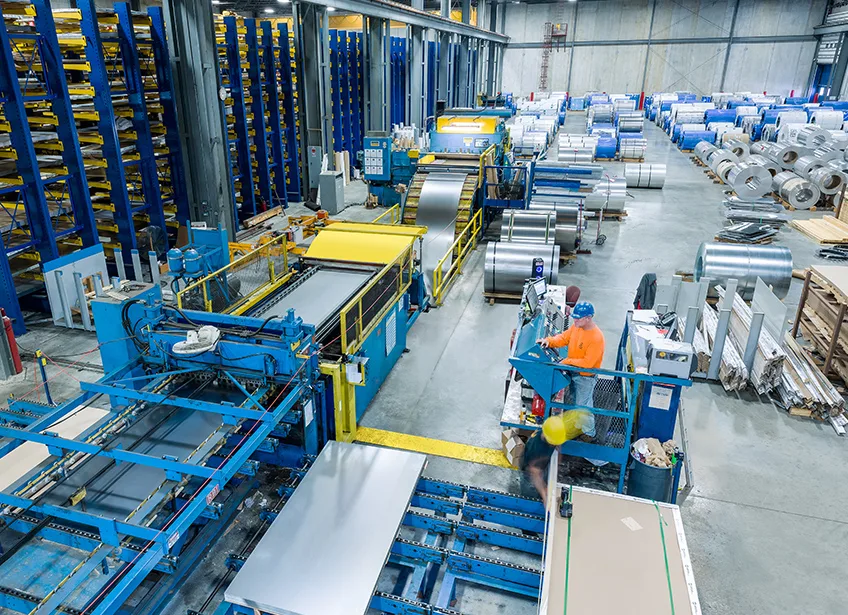
- Precision hardware: Laser-guided 9-roller systems enable 0.15mm/m dynamic compensation; DLC diamond-coated rollers triple wear resistance.
- Data-driven intuition: Master operators compile "bend force-rebound maps" from 100,000+ datasets for instinctive tuning.
- Thermal-process synergy: Integrating induction heating into high-strength leveling lines reduced cutting distortion from 12% to 1.5% in one implementation.
Baohui Steel Limited
As the one-stop steel solution provider, we has professional leveling experience and the most advaced machine. If you need coils or coil leveling, contact our technical expert for further information.